
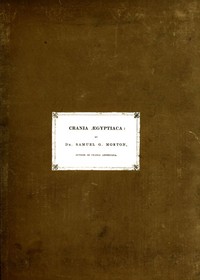
Crania Ægyptiaca by Samuel George Morton
Okay, let's break this down. This isn't a novel with a plot. 'Crania Ægyptiaca' is a scientific treatise from 1844. The 'story' is the argument its author, Samuel Morton, is trying to make. He measured the internal capacity (cubic inches) of hundreds of skulls from his personal collection, grouping them by what he called the 'Caucasian,' 'Mongolian,' 'Malay,' 'American,' and 'Ethiopian' races.
The Story
Morton's main goal was to prove that human races were separate, unchanging biological categories, created that way. He focused on ancient Egyptian skulls because he thought they showed that racial differences were fixed for thousands of years. He presented tables of numbers showing, in his view, that 'Caucasians' (including ancient Egyptians) had the biggest brains, and 'Ethiopians' had the smallest. He used this 'evidence' to argue for a hierarchy of intelligence and civilization. The conflict isn't in the pages, but between his flawed science and the real, diverse humanity it claimed to describe.
Why You Should Read It
This is a tough but vital read. You're not reading it to agree with Morton. You're reading it to see the machinery of scientific racism up close. It shows how numbers and charts can be used to make prejudice look objective. It's sobering to see a smart, educated person be so completely wrong because of his cultural biases. Reading the original text strips away the myth that racism was always just ignorant hatred; sometimes, it wore a lab coat and used calipers. It makes you critically examine how 'data' is collected and interpreted, even today.
Final Verdict
This book is not for casual entertainment. It's for anyone interested in the history of science, the history of racism, or the sociology of knowledge. It's perfect for students of history or anthropology who want to understand one of the foundational (and deeply flawed) texts of their fields. If you enjoyed books like 'The Immortal Life of Henrietta Lacks' or 'Medical Apartheid' that explore ethics in science, this is the historical source material for that kind of discussion. Approach it as a primary document—a fossil of a dangerous idea—and it becomes a profoundly educational, if unsettling, experience.
Jennifer Brown
3 months agoCompatible with my e-reader, thanks.
Mary Davis
1 year agoPerfect.
Charles White
1 year agoPerfect.
Margaret Taylor
10 months agoTo be perfectly clear, the content flows smoothly from one chapter to the next. This story will stay with me.